
What you eat may do more for your mood than you realize — and the science is more nuanced than any headline suggests
The link between plant-based diets and depression and anxiety symptoms has quietly moved from fringe nutrition circles into peer-reviewed journals — and for good reason. For many people, what ends up on their plate each day may be shaping how they feel long before any other lifestyle factor gets a chance. This isn’t about miracle foods or eliminating entire food groups overnight. It’s about understanding a surprisingly intimate relationship between the gut, the brain, and the choices we make at mealtimes.
Mental health has a scale problem. While conversations about therapy, medication, and mindfulness have rightly expanded, one factor tends to get overlooked in clinical settings: what people eat every single day. For the millions living with low-grade depression or persistent anxiety, the search for manageable, accessible strategies is real and ongoing.
The financial and human cost is staggering. Yet research consistently shows that most people with depression receive no treatment at all — often because of stigma, cost, or access barriers. This is precisely why dietary approaches deserve serious, nuanced attention. They don’t replace professional care. But they may offer one more meaningful lever to pull.
Could something as everyday as choosing lentils over processed meat, or adding leafy greens to dinner, have a measurable effect on depressive and anxious thinking? Research suggests it might — and the mechanism is more biological than motivational.
Here’s a question worth sitting with: if roughly 90% of the body’s serotonin is produced in the gut, not the brain, then why would we assume that what we eat has no bearing on our mood?
The gut-brain axis is a bidirectional communication network linking the central nervous system to the enteric nervous system — the vast web of neurons lining the digestive tract. This system communicates through hormones, immune signals, and the vagus nerve. At the centre of this network sits the gut microbiome: trillions of bacteria whose composition is directly shaped by dietary intake.
This isn’t a vague correlation. Research published in journals including Nutritional Neuroscience and the BMJ has tracked these connections in population-scale cohorts. The inflammation pathway is particularly important: chronic low-grade inflammation — commonly driven by poor dietary habits — has been identified as a factor in both depression and anxiety. Anti-inflammatory plant foods may, over time, help reduce this biological burden.
| Dietary Pattern | Effect on Gut Microbiome | Associated Mental Health Impact |
|---|---|---|
| High Ultra-Processed Foods | Reduced diversity, pro-inflammatory species increase | Higher risk of depression; elevated anxiety markers |
| Mediterranean Diet | Diverse microbiome, SCFA production | 33% lower depression risk in large cohort studies |
| Plant-Based / Whole-Food | Fibre-fed beneficial bacteria thrive | Lower inflammation; improved mood regulation signals |
| High Refined Sugar | Feeds pathogenic bacteria; reduces Lactobacillus | Increased mood volatility; impaired sleep quality |
| Omega-3-Rich Diet | Supports anti-inflammatory microbiota | Linked to reduced depressive episode severity |
Table: Dietary patterns and their documented associations with gut health and mental wellbeing. Sources: BMJ Open, Nutritional Neuroscience, SMILES Trial.
Think of the brain as a high-performance engine. It needs the right fuel — not occasionally, but consistently. A plant-based diet, when well-constructed, delivers a dense array of micronutrients, antioxidants, and phytocompounds that directly support neurological function. It’s less like a switch being flipped and more like a garden being tended over seasons.
Consider folate — found abundantly in dark leafy greens, legumes, and citrus. Folate plays a critical role in the methylation cycle, which regulates the synthesis of serotonin, dopamine, and norepinephrine. Low folate levels have been linked to increased depressive severity and poorer response to antidepressant medication. This isn’t anecdote; it’s biochemistry.
Or take magnesium — one of the most under-appreciated minerals in mental health conversations. Found in nuts, seeds, legumes, and whole grains, magnesium regulates the hypothalamic-pituitary-adrenal (HPA) axis: the body’s central stress response system. Many adults fall well short of the recommended daily intake, and research suggests this shortfall correlates with heightened anxiety reactivity.
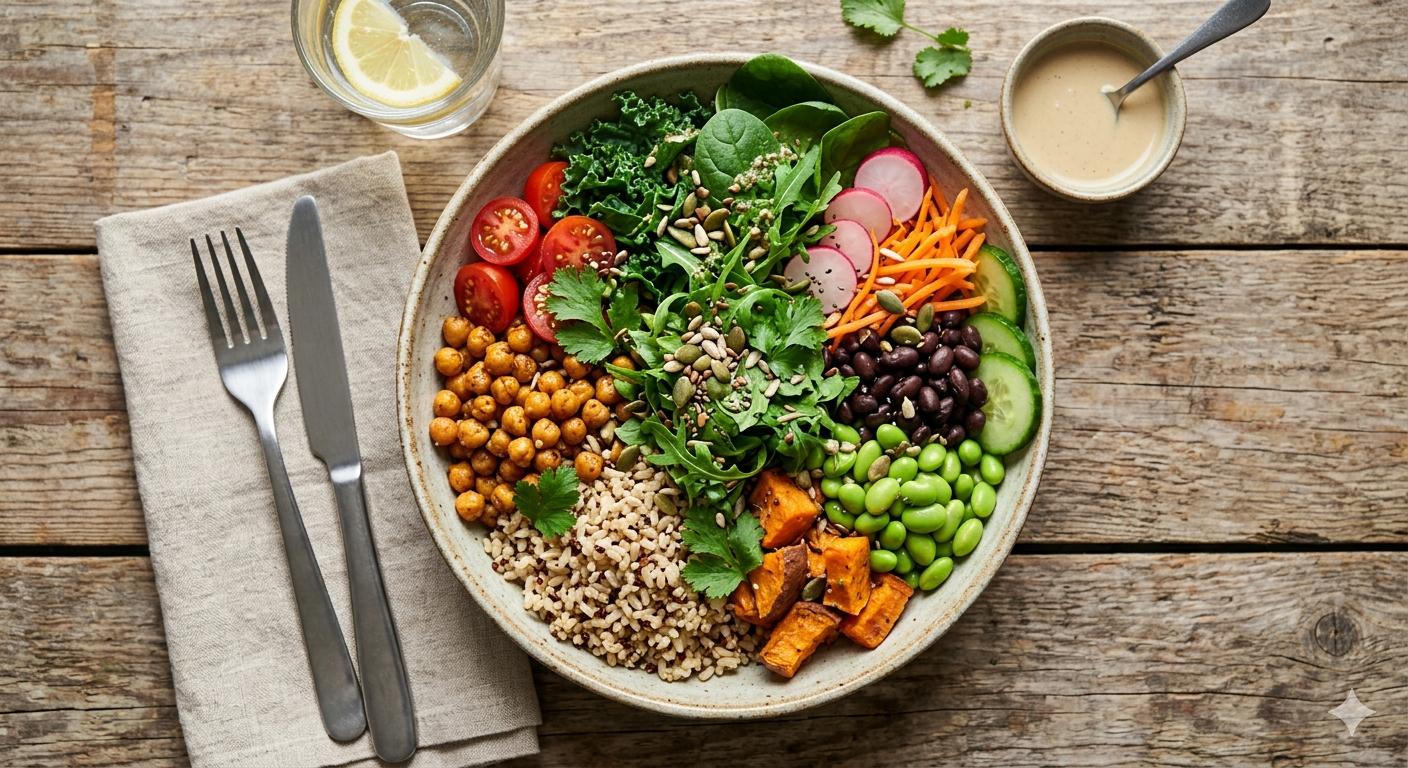
None of this demands a rigid or extreme approach. For many people, gradually increasing plant diversity — adding a daily handful of walnuts, swapping refined grains for quinoa or barley, filling half the plate with vegetables — may be enough to shift the internal biological environment meaningfully.
1
Add before you eliminate
Rather than removing foods immediately, begin by adding more plant-based options to each meal. Aim for 30 different plant foods per week — a benchmark associated with greater gut microbiome diversity in research. This includes vegetables, fruits, legumes, whole grains, nuts, seeds, herbs, and spices. Variety matters as much as volume.
2
Prioritise mood-supportive nutrients daily
Focus on getting adequate omega-3 fatty acids (walnuts, flaxseeds, chia seeds), folate (spinach, chickpeas, asparagus), magnesium (pumpkin seeds, black beans, almonds), and zinc (hemp seeds, lentils, oats). If following a fully plant-based diet, consider a B12 supplement — this nutrient is not reliably available from plant sources.
3
Reduce ultra-processed and high-sugar foods gradually
Abrupt elimination often backfires. Instead, identify two or three ultra-processed items consumed regularly and replace them over several weeks. Swap sweetened yogurt for plain yogurt with berries; replace white bread with wholegrain sourdough. Consistency over time matters more than perfection in a single meal.
4
Support the gut-brain connection directly
Include fermented plant foods — kimchi, sauerkraut, miso, tempeh, kombucha — which introduce beneficial bacterial strains. Pair these with prebiotic-rich foods (garlic, leeks, oats, slightly green bananas) that feed existing gut bacteria. Think of it as seeding and feeding the internal ecosystem simultaneously.
5
Eat regular meals and protect blood sugar stability
Irregular eating patterns and blood sugar spikes — common with processed food reliance — can directly amplify anxiety symptoms through cortisol and adrenaline fluctuations. Aim for three balanced meals that each combine protein, complex carbohydrates, healthy fats, and fibre. This alone can noticeably reduce afternoon mood dips for many people.
The wellness industry is, unfortunately, not always a reliable guide. Well-meaning but oversimplified advice can lead people to approaches that backfire — sometimes worsening the very symptoms they hoped to address. What are the most common missteps?
It’s also worth noting that food anxiety itself can become a source of psychological distress. If tracking, restricting, or eating “correctly” starts to feel like a compulsion rather than an act of self-care, that’s an important signal to pause and speak with a healthcare professional.
Nutritional psychiatry — the formal study of how diet affects mental health — has grown rapidly over the past decade. The field gained significant credibility through the work of researchers including Professor Felice Jacka of Deakin University, whose longitudinal research demonstrated that dietary quality in adolescence predicts depression risk in adulthood — independent of socioeconomic status, physical activity, and other confounding variables.
The data now clearly show that diet quality — independent of other factors — has a meaningful association with mental health outcomes across the lifespan. We’re not suggesting diet is the whole story, but it’s an important and largely overlooked piece.
— Adapted from research perspectives in nutritional psychiatry; see Harvard Health: Nutritional Psychiatry — Your Brain on Food
A 2022 systematic review published in Molecular Psychiatry analysed 16 randomised controlled trials examining dietary interventions and depressive outcomes. The review found consistent, statistically significant improvements in depressive symptoms in groups receiving dietary guidance — particularly interventions based on whole-food, plant-predominant eating patterns.
Separately, research into the relationship between dietary fibre intake and anxiety outcomes has found that adults consuming below recommended fibre thresholds are significantly more likely to report anxiety symptoms. The proposed mechanism involves both direct microbiome effects and the role of short-chain fatty acids in modulating stress-response pathways.
Eating more plants, reducing processed food, and tending to nutritional gaps can support mental wellbeing meaningfully. For some people, these changes make a noticeable difference in energy, mood stability, and resilience. But they are not sufficient for everyone, and they are not designed to be.
If you’ve been experiencing persistent low mood, loss of interest in things that previously brought pleasure, heightened anxiety that interferes with daily functioning, or thoughts of self-harm, these are signs that professional support is needed — not optional. A GP, psychiatrist, or clinical psychologist can conduct a proper assessment and discuss the full range of evidence-based treatments available.
There is something quietly compelling about the idea that a bowl of lentil soup, a handful of walnuts, or a plate of roasted vegetables might contribute — even modestly — to how steady and manageable a day feels. Not as a cure. Not as a promise. But as one genuine, tangible thing a person can do.
The evidence base for plant-rich diets and mental health is growing with each year, and the mechanisms are becoming clearer. The gut-brain connection is real. Inflammation matters. Nutritional gaps have consequences. And the reverse is also true: addressing those gaps, diversifying plant intake, supporting the microbiome — these things appear to carry genuine psychological benefit for many people.
What’s one plant food you could add to your week — not because you have to, but because you’re curious what it might do?
Discover evidence-based strategies for supporting mental wellbeing through lifestyle — including sleep, movement, stress management, and food.
Posted 5:38 pm | Wednesday, 20 May 2026
| nm